

Today’s digital environment doesn’t merely accelerate information and opinion. It shapes mindsets and influences behavior.
Social media platforms now shape meaning, attention, and authority at unprecedented speed—altering not just how ideas travel, but how power is perceived, formed, rendered and felt. They have quietly traded the handshake for the algorithm, and debate for the echo chamber.
To understand what is happening now, one must also understand where it began: the ideas, myths, institutions, and middle-class aspirations that shaped the United States—and the extraordinary global influence it went on to wield.
Uncle Sam 2.0 invites readers to look both backward and forward. It examines how a nation built on ideals of freedom, innovation, and leadership became a global hegemon—and how those same forces are now being tested, repurposed, or distorted in the algorithmic age.
The book is written for students, globally engaged readers, educators, analysts, and the simply curious—those who want to understand not just today’s headlines, but the deeper mechanics behind them. It explores how power concentrates, how belief turns into loyalty, how movements harden into cults, and how societies oscillate between order and chaos when feedback loops are amplified, bent, or captured—as algorithms take center stage, in a world where the software for democracy is collapsing.
Rather than offering neat answers—few of which genuinely exist in this moment—Uncle Sam 2.0 provides coordinates: conceptual tools to trace the rise, reach, and recalibration of American power in an era of systemic turbulence. History reminds us that periods of uncertainty have often demanded new moral bearings and strategic clarity—from leaders such as Roosevelt, Lincoln, Gandhi, Mandela, King, and others who gave hope and helped societies and countries re-orient, when old maps failed.
In its final section, the book quietly shifts from diagnosis to reflection. Readers are invited to engage with civic compass maps—not as prescriptions, but as prompts—to think about values, trade-offs, and direction in a world where the coordinates of power, belief, and influence are being redrawn.
Quo Vadis? is no longer a rhetorical question. It is a practical one.
Uncle Sam 2.0 is a ‘heads-up’ for a generation sensing the ground move beneath its feet—and looking for clarity, perspective, and orientation as the road ahead takes shape.
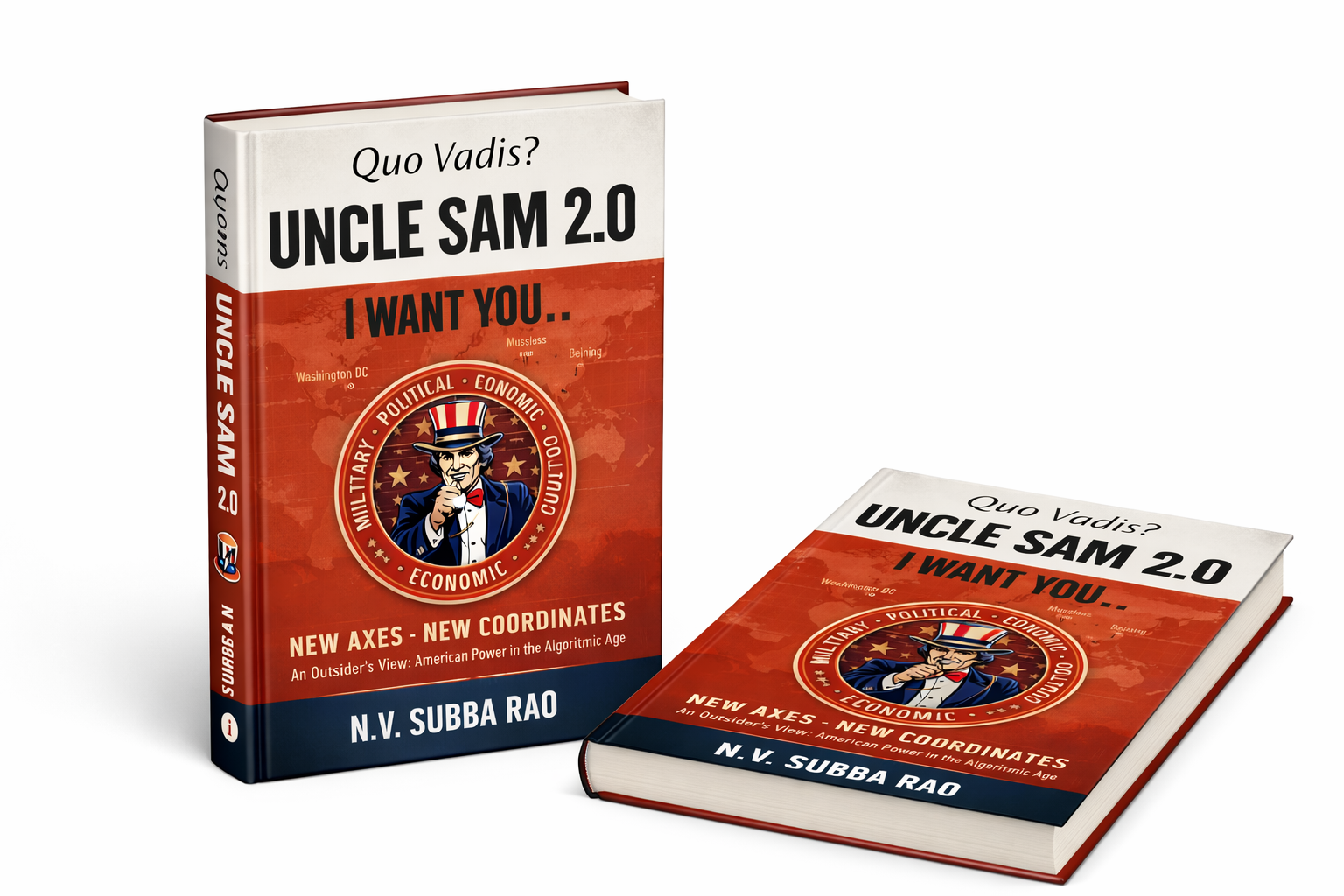
 The book